Table Of Content

While the Titanic split passengers into first, second and third classes, today’s cruise ships would never do something so possibly offensive. Instead, they offer upgrades upon upgrades, and those who pay for those pricey upgrades get the best treatment. However, the likelihood of a modern cruise ship sinking due to an iceberg collision is extremely low.
Safety Precautions It’sarison
Offering a variety of options that cater to different age groups and preferences. Unlike the Titanic’s limited pool facilities, contemporary vessels often feature multiple pools strategically placed throughout the ship. Passengers can choose between serene adult-only pools for relaxation or lively family-friendly pools filled with laughter and splashes.
Cabin and amenity comparison: Titanic vs. modern cruise ships
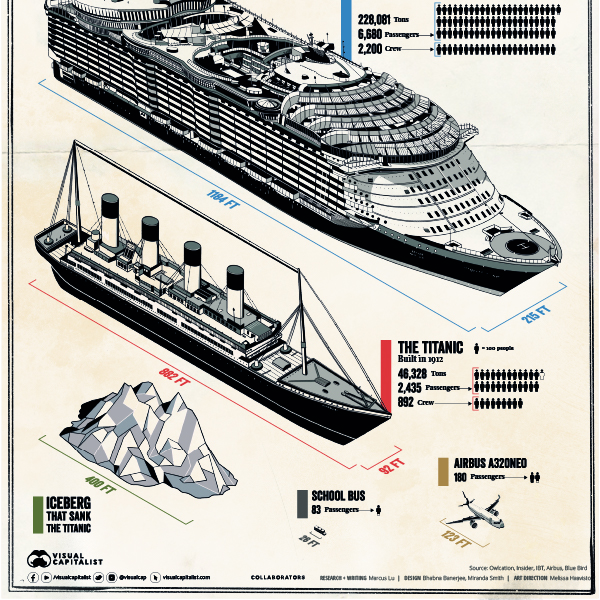
The ship’s gross tonnage was 46,000, which was also impressive for the time. So, how big was the Titanic compared to a cruise ship built in today’s modern age? When the Titanic was completed in 1912, it had a length of 882 feet (269.1 meters), which surpassed Lusitania’s length at 787 feet (239.9 meters), having a difference of almost 100 feet. The Titanic was second of the three Olympic-class ocean liners overseen by the White Star Line. Read on to learn more about how big was the Titanic compared to a cruise ship built today, including differences between the old and new ships. As a comparison, the modern-day Symphony of the Seas cruise ship can hold up to 6,780 passengers – nearly twice as much as the Titanic.
Icon of the Seas vs. Titanic: Passenger Space Ratio
However, those were of little use, given the temperature of the water and the quick onset of hypothermia. As such, the Titanic’s cabins and common spaces were decked out with elegant European-style decor, with sweeping staircases (yes, including the one from the movie), ornate woodwork and luxurious furnishings. After all, if the Titanic was a huge ship just about a hundred years ago, surely it is still at least a moderately large ship by today’s standards… right? The Titanic was famously declared “unsinkable” due to its design, which included a double-bottom hull and 16 watertight compartments. The doors were designed to close manually or automatically at the water level.
That makes the new ship twice as tall (excluding Titanic’s towering funnels) and over twice as wide, as well as nearly 5.5 times larger volumetrically. If anything, it’s the two vessels’ lengths that are the closest to one another. The graph below shows the length of Titanic in comparison to the Royal Caribbean fleet. It’s interesting to note that although lengths of cruise ships have increased on average cruise ships aren’t much longer than Titanic was. What many people who are new to cruise ships fail to understand is the fundamental shift leisure cruising underwent in the second half of the 20th century. Ocean liners and ferries evolved into the cruise ships that we know today.
The Titanic’s captain, Edward Smith, canceled the scheduled lifeboat drill the day the ship encountered the iceberg. In contrast, modern cruise ships routinely conduct lifeboat drills shortly after embarkation, familiarizing passengers with evacuation procedures and mustering points in the event of an emergency. The scope and scale of activities on modern cruise ships have expanded significantly since the Titanic’s maiden voyage. Gone are the days when swimming was only possible during warm weather conditions on a cruise ship.
Icon of the Seas vs. Titanic: A Cruise Ship and an Ocean Liner
At the time it was launched, the RMS Titanic was the largest seagoing vessel ever built. However, since much larger modern ships have been constructed, the Titanic has dwarfed in size. While a modern cruise ship or ocean liner may dwarf the Titanic in scale, it was considered a truly remarkable engineering marvel of its time. Where the main focus of a cruise ship is a leisurely voyage where time spent on the ship is the primary purpose of the trip, an ocean liner, like the Titanic, was designed for more practical transportation. With a decade of firsthand experience in the cruising industry, I have developed a deep understanding of the intricacies and wonders that these majestic vessels hold. Due to the poor and outdated safety features, there are over 1503 lives lost in that incident.
In Terms of Other Features and Amenities
One of the easiest ways to visually compare a cruise ship is by looking at the length. The Titanic was 882 feet long, and when you take all modern cruise ships into account, including dedicated exploration ships, the average is around 830 feet. By comparing the size of the Titanic to modern cruise ships, readers can gain a better understanding of how far shipbuilding technology has come in the past century. It also provides insight into the challenges and limitations faced by engineers and architects when designing and constructing ships of this magnitude. Perhaps one of the most visually striking differences between the Titanic and modern cruise ships can be seen in the number of funnels.
10 Ways The World's Largest Cruise Ship Compares To The Titanic - TheTravel
10 Ways The World's Largest Cruise Ship Compares To The Titanic.
Posted: Tue, 20 Dec 2022 08:00:00 GMT [source]
What is the worlds largest cruise ship?
Another significant development in modern cruise ships is their eco-friendly technology. Many ships use advanced systems to minimize their environmental impact, such as energy-efficient engines, waste management systems, and even harnessing solar power. Cruise lines are making conscious efforts to be environmentally responsible and sustainable.
Surprisingly, the draft of large ships like the Titanic and modern cruise ships hasn’t changed significantly. For instance, the Titanic had a draft of 33 ft. (10 m), allowing it to navigate deep waters comfortably, whereas modern cruise ships like Icon of the Seas have a slightly lower draft of 30 ft. (9 m). Despite everything aboard cruise ships today, from waterslides and racetracks to multi-story theaters, the Titanic was actually the most comfortable and amenity-packed ocean liner when it debuted. Some of that glamour can be seen in the 1997 film “Titanic,” which dramatized the ship’s first and only journey. Décor included ornately carved woodwork, European furnishings, and gilded touches.
Modern cruise ships are equipped with state-of-the-art navigation systems that utilize satellite technology, radar, and sonar to ensure accurate positioning and safe navigation through treacherous waters. However, the length of modern cruise ships has surpassed this historical vessel, with some exceeding 1,000 feet. Other entertainment-geared spaces included a squash court, smoking room, lounge, reading and writing room and promenade. You would not, however, unlike on today’s cruise ships, find huge theaters or cover bands. Instead of a spa, there was a Turkish bath, steam room and massage room. There was only one pool, compared to the many, many water attractions you’ll find on today’s cruise ships.
Unlike ocean liners which travel long distances over periods of days, cruise ships don’t usually require fast speeds as they typically travel short distances between ports over the span of days. Ocean liners serve the primary purpose of transporting passengers or goods from one destination to another. Unlike cruise ships which are often a destination in and of themselves, ocean liners serve as a means of transportation.
Each of these ships has seven neighborhoods that cater to their passengers’ every whim and needs. Unlike the Titanic, where many passengers were given basic, shared accommodations in the third-class decks, modern cruise ships have the space and decks required to provide all passengers with private cabins. Where cruise ships of the day were designed to make multiple stops at various ports, ocean liners were designed to carry passengers between one continent and another. Passengers can indulge in gourmet cuisine, enjoy Broadway-style shows, participate in thrilling water slides, hit the gym, or simply unwind and soak up the sun. But if there ever was a breach on Icon, double hull structures and enhanced watertight compartments could better defend against flooding. Let's now compare the Titanic vs modern cruise ships on each major metric.
In contrast, during the time of the Titanic, navigational aids were limited to methods such as celestial navigation using stars or compass readings. The introduction of GPS has revolutionized maritime navigation by providing real-time location data, enhancing safety measures aboard modern cruises. To cater to the growing demand for immersive experiences, modern cruise ships have embraced virtual reality (VR) technology. Passengers can step into a virtual world and embark on thrilling adventures without leaving the ship’s premises. Whether it’s exploring ancient ruins or diving into the depths of the ocean, VR experiences provide an extra layer of excitement and entertainment.



No comments:
Post a Comment